
The Classic Everest Trek via Jiri is a legendary Himalayan journey that follows the historic approach used by early Everest expeditions before the construction of the Lukla airstrip. Rather than flying directly into the high mountains, this 25-day adventure gradually leads you from the middle hills through diverse landscapes, traditional villages and Sherpa country to the foot of Mount Everest. The slow progression through changing altitudes and environments makes this one of the most rewarding ways to experience the Everest region.
The adventure begins with a scenic drive from Kathmandu to Jiri, the traditional gateway to the Everest region. From Jiri, the trail passes through Shivalaya, Bhandar and Sete before crossing the spectacular Lamjura Pass (3,570 m). The Jiri-to-Lukla section is considerably quieter than the main Everest trail, offering a more peaceful trekking experience through rhododendron, magnolia, maple, birch, pine and fir forests. Along the way, you encounter traditional Rai, Magar and Sherpa communities, terraced hillsides, mountain streams and remote settlements that reveal a less-visited side of the Everest region.
From beautiful Junbesi, the landscape gradually becomes more alpine as the trail continues toward Nunthala, Bupsa, Chheplung and eventually Namche Bazaar (3,450 m), the vibrant trading centre and cultural heart of the Khumbu. With dedicated acclimatization days in Namche and Dingboche, the itinerary allows your body to adjust progressively to increasing altitude before continuing toward the high Himalayas.
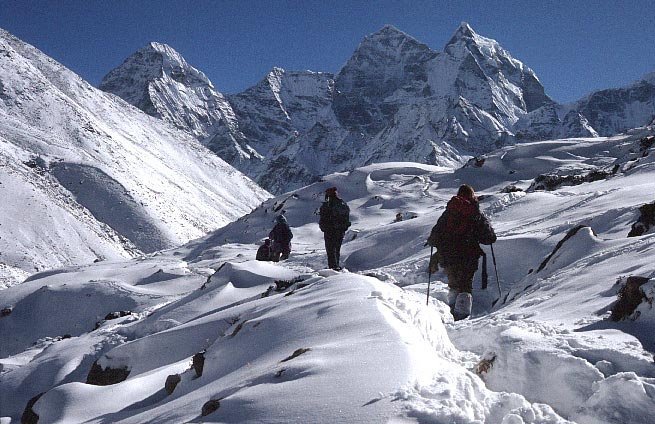
Beyond Namche, the trail passes through the spectacular villages of Tengboche and Dingboche, with magnificent views of Ama Dablam, Thamserku, Kwangde, Lhotse and Everest. Tengboche is home to the famous Tengboche Monastery, one of the most important Buddhist monasteries in the Khumbu. As the trail climbs above the tree line, the scenery transforms into a stark and dramatic world of glacial valleys, high mountains and rugged Himalayan terrain.
The ultimate objective is the Everest Base Camp and Gorak Shep area, where the scale of the Khumbu Glacier, surrounding peaks and the Everest massif becomes truly overwhelming. The journey combines the achievement of reaching the Everest Base Camp region with the cultural and historical richness of the trail that made the early Everest expeditions legendary.
The return journey descends through Pangboche, Kyangjuma and Namche before continuing to Lukla, from where a short mountain flight brings you back to Kathmandu. More than simply a trek to Everest, the Classic Everest Trek is a journey through the history, landscapes and cultures that have shaped the story of Himalayan mountaineering.
Today is your arrival day. we welcome you upon your arrival at Kathmandu’s Tribhuvan International Airport. Transfer to Hotel in Kathmandu. Prior to the activities, arrange a meeting with your guide for briefing about the necessary formalities on your tour and trek program. Depending upon your arrival time you may spend free time visiting nearby historic/Countryside areas.
Enjoy a full day sightseeing of ancient habitats dominated by Newars in Banepa, Panauti and Dhulikhel of Kavre District. Thery embody pastoral characters. You explore this Heritage Sites enlisted by UNESCO with your guide. Here, the Hindu shrines and temples boast a unique fusion of Hindu- Buddhist flavor, carved and designed in Newari architecture. They reflect the golden era of Nepal. There is time to explore the city’s many places of interest with your guide or in your own or take a rest. Our Trek Leader/Guide meets you in the afternoon for the trek briefing and for the final trek preparation where you have chances to discuss on the pre trek departure information. In the evening sample a delicious traditional Nepali Welcome dinner in authentic Nepali Restaurant with the cultural dances that represents different customs and music instruments of Nepal. Private vehicle is there for you to pick up and drop in Hotel with our staff.
Today Our Leader/guide pick you up from your hotel early in the morning to start your historic Classic Everest Trek which is nearly 7 hours spectacular drive from Kathmandu to Jiri by a private vehicle. Jiri is nearly 190 km east of Kathmandu. Follow the ancient Tibet Trade route which is also called Araniko Highway. There are exciting white water Rivers, nice environment of Flora and Fauna. The highway gets narrower winding up. This is the scenic drive in autumn, spring and in winter enjoying the best central mountain views to the east Everest region Mountains. We stay Overnight in Jiri. Jiri was the main headquarter or a gate way to supply food for Everest people before the Lukla airport was pitched.(7 hours)
Firstday of our trek starts at the end of the rough motorable road in circular Market Jiri. After crossing a stream, the track leaves the road and starts to climb uphill through pine trees to several wooden bhattis (local tavern) at the tiny settlement of Bharkur. We keep climbing to the Mali Danda (2440m), from where there are excellent views of the Gaurishanker, Rolwaling peaks. Beyond Mali Danda we descend into the Khimti valley through the sparsely populated Sherpa, Magar, Rai settlement of Mali at 2220m and continue our way to the crossing of the Yelung Khola River at 1860m. After crossing the Khimti River on another New suspension bridge we reach Shivalaya (4 hrs).
From Shivalaya we start the day with steep rough uphills towards the pass at Deurali (2730m). On our way to this pass we cross numerous streams and walk through the villages of Sangba Danda (2180m), Kharubas (2330m) and Mahabhir (2590m). From Deurali Pass we steeply descend on stone steps through fields and pastures to Bhandar, where we spend the night. Bhandar is an interesting Mixed Ethnic Village where the people still have pride of accommodating and entertaining several Expedition groups back in 1980’s (5 hrs).
From the village square at Bhandar the trail descends and ascends several times through the lower terraces of the multiethnic farmer’s settlement then we pass the small settlements of Doharpa and Baranda before we cross the Thado Khola River on a new suspension bridge at 1480m. As we follow the east bank of the River we climb towards Kenja (1600m), the headquarter inhabited by Newars and Magars. As we leave Kenja we start to ascend steeply towards Chimbu (2170m) where there are chances to see Himalayan Monkeys and continue on towards Sete where we spend the night (7 hrs).
From today our trek goes through the original sherpa villages wisdely known as Sherpa Land and starts by climbing from Sete to the top of the 3570m high Lamjura Pass. The trail is scenic and varied through forests of rhododendron, magnolia, maple and birch. This section of the trail is also well known for spotting birds like sunbirds, minavets, flycatchers, laughing thruses and many others. Lamjura Pass is the highest point on the trek between Jiri and Namche Bazaar and is marked by a triangle of Prayer stones and prayer flags.Here we see place that the Classic Sir Edmund Hillary group commenced their expidition. On the eastern side of the pass the route descends steeply for about 400m through fragrant fir and hemlock forests and then levels out passing the small village of Tragdobuk (2830m). Continuing our way down we arrive in Junbesi, a splendid Sherpa village amid beautifull surroundings (6 hrs).
Leaving Junbesi in the morning we cross the Besi Khola River and climb steeply uphill, contouring above the houses to the end of the ridge. From here we have excellent views of Everest, Thamserku (6608m), Kantega (6779m) and Mera Peak (6654m). This is the first view of Everest on this trek, although the lower peaks in the foreground seem to dwarf the higher, more distant mountains. After passing the Ringmo River, the trail ascends to Ringmo village, with its abundant fruit orchards. Beyond Ringmo we climb to the Takshindu La pass (3071m), where we can see the isolated monastery of Takshindu, a superb example of Sherpa architecture. We now descend through forests of conifer and rhododendron, passing shepherds’ huts and bhattis alongside the trail until we reach Nunhala (6 hrs).
From Nunthala the descend continues to the Dudh Kosi (Milky River) and cross this River using a long suspension bridge (1510m). Our trek then climbs out of the River valley through fields of barley, wheat and corn to the sprawling Rai village of Jubing (1680m). We continue to climb up a ridge to a Sherpa village named Khari Khola (2010m). Beyond this village we climb past some water driven mills to Bupsa (5 hrs).
Our trek today starts with a gentle climb, passing the village of Kharte and continues on through forests inhabited by monkeys. From this part of the trek we can admire views of Cho Oyu (8153m). We keep climbing the ridge till we reach the teashop on Khari La pass at 2840m. From the pass, the trail descends into the deep canyon of Poyan Khola. After crossing this River on a wooden bridge we reach the small settlement of Poyan (2770m). The trail climbs up and down for about an hour after Poyan to a ridge that offers a good view of the Khumbu region and then descends 500m towards Surkhe (2290m). Continuing our trail upwards again, we climb through a jumble of boulders, passing some wonderful Mani walls until we reach the village of Chheplung (6 hrs)
After leaving Chheplung we cross the Thado Kosi River on a suspension bridge. Just past the bridge we can see the peak of Kusum Kangru (6367m), ahead the trail, which is the most difficult of the so-called “trekking peaks”. Beyond the Thado Kosi the trail climbs a bit towards Ghat Village (2790m), we cross a ridge marked with painted mani stones and climb to Phakding. From Phakding we follow the valley of the Dudh Kosi River, staying on the west bank of the River. We climb steeply over a rocky ridge towards Benkar (2710m). From here the trail continues alongside the River. All along this part of the trail, villages are interspersed with magnificent forests of rhododendron, magnolia and giant firs with the views of Holy Khumbhila of Everest Region. In both the early autumn and late spring, the flowers on this portion of the trek make it a beautiful walk. We cross the Kyashar Khola River and climb out of the valley to Monjo (2840m). Just beyond Monjo the trek enters the Sagarmatha (Everest) National Park, which was established in 1976 to protect a 1148 sq km area surrounding Mt Everest. Beyond the national park entrance station, the trail makes a steep rocky descend and crosses the Dhud Kosi River on a 120m-long suspension bridge towards Jorsale (2830m).We encounter lots of brave porters and Yaks on the way up and down with lots of Loads in their back for the supply.It is ages old system of transportation here because of the difficult difficult topography. After crossing this River we be walking right side of the River for nearly and hour before we cross another suspension bridge above the junction of Bhote Kosi and Dudh Kosi River.Then we have nearly three hours gradual and steep uphills viewing Mt Everest,Lhotse and Taboche in the clear day to the Capital of the Everest Region through(3465m) pine, conifers,birch, rhododendron forests. Namche Bazaar is the main trading centre in this region and features numerous shops, hotels and restaurants.Namche Bazar gets big weekly market on Friday and Saturday where all Mountain tribes gather around to supply 30% foodstuffs for the area carried by porters and in animal(Jokpe-hybrid of local cow and the yak back) 6 hrs.
Today we rest in Namche for the Acclimatisation Excursion.It is important before proceeding higher.We can do various activities in this important place to give your body time to acclimatize and rest well.After BreakfastWe take you up to the highest airstrip of the World Syangboche airstrip(3790m) after an hour scenic uphills.You start enjoying Amadablam,Thamserku, Kwangde,Kusum Kangru while you are walking up.To see further exciting views we take you to the Everest View Hotel.On the way you start enjoying mighty Everest and more and the time in View Hotel(3890m) gives you the day’s fun.Having couple of drinks we descend down Namche to have Lunch and rest for couple hours.In the midday our guide takes you to the Sagarmatha Museum inside Army Barrack to know interesting things of the Everest Region. After the couple of climb high sleep low activites make you feel a lot better in the further higher up trekking days. We suggest you to drink plenty of fluids henceforward to rehydrate yourself (4 hrs).
Our route today to Tengboche weaves in and out of side valleys, making small ups and downs, to the teashops of Kyangjuma, and joins the trail from Khumjung just before a collection of mani stones. The views of Everest and Ama Dablam are excellent from this part of the trek. We pass the small settlement of Sanasa from where the trail drops towards Phunki Tanga (3250m) where you liked the water driven prayer wheels making continuous sweet natural melody. From here the trail climbs steeply through rhododendron forests as it follows the side of a hill to the saddle on which the monastery of Tengboche sits at 3870m.On the way up one would be lucky to see the wild Himalayan Thar (goat). The view from here is rightly deemed to be one of the worlds most magnificent. Kwangde (6187m), Tawachee (6542m), Everest, Nuptse, Lhotse (8501m), Ama Dablan, Kantega and Thamserku provide an inspiring panorama of Himalayan giants. We spend the night in Tengboche Monastery village (5 hrs).
From Tengboche we start our day by descending through forests of birches, conifers and rhododendrons to the village of Dibuche. From here the level trail passes many mani walls in a deep rhododendron forest. After crossing the Imja Khola River the route climbs past some magnificently carved mani stones to Pangboche (3901m). This is the highest year-round settlement in the valley, and the Pangboche gompa is the oldest in Khumbu once contained relics that were said to be the skull and hand of a yeti. Beyond Pangboche the route enters alpine meadows above the tree line, mostly consisting of scrub juniper and tundra. We cross Imjatse River and arrive in Dingboche, which is a labyrinth of walls and pastures.Dingboche is the valley made by Imjatse River that flows down from the Island peak.This is the best valley to be to feel just in the lap of the beautiful Mountain Amadablam,Kantega and other peaks. (5 hrs).
The most important important thing for acclimatization in high altitudes is a slow ascend. Therefore it is imperative that we spend an additional night at Dingboche to aid the acclimatisation process. A good way to spend the day is to hike to the Nzagazong Parbat to the hight of 5000m from where the views are just marvellous. From here we have majestic views of Island Peak (6189m), therehearsal trekking peak, south face of Lothse and the giant of Ama Dablam,Mt. Makalu(8030m). After enjoying the views here we return back to Dingboche (4 hrs).
From Dingboche the trail goes directly up the meadow facing the Lobuche east and west Peaks and up after an hour walk the terminal moraine of the Khumbu Glacier for about an hour to the memorial area known as Chukpilhara, which was build in memory of six Sherpas who died in an avalanche during the 1970 Japanese skiing expedition on Everest. From here the trail drops a bit and follows the western side of the valley to Lobuche, a summer settlement at 4930m that has become a major trekking stop. The sunset on Nuptse, seen from here, is a memorable sight(4hrs).
The first section of today’s trail follows the western side of the broad Khumbu valley and ascends gently through meadows besides the glacial moraine. The ascend becomes steeper and rougher as it crosses several side moraines. After rounding a bend in the trail, the conical peak of Pumori comes into view. On the lower slopes of this mountain a ridge extending to the south terminates in a small peak, known as Kala Pattar (5545m), meaning 'black rock'. The trail then makes a short descend onto the sandy, flat expanse of Gorak Shep. From here we continue to the current Everest base camp, which is about a 4 hours return walk from Gorak Shep. We return to this small settlement after our visit to the base camp (6 hrs).
After an early morning rise we start our day by climbing the Kala Pattar (5550m). This is a steep ascend up the grassy slopes west of Gorak Shep. From Kala Pattar the entire Everest south face is visible as well as Lho La (the pass between Nepal and Tibet, also named the Western Cwm), Changtse (the northern peak of Everest) and most of the West-Ridge route. We return to Gorak Shep and continue to descend to Lobuche (6 hrs).
We go to Pangboche retracing our steps back to Dughla, and then go straight down the hill crossing the Khumbu Glacier from the bridge to reach a valley trail. Here is Pheriche which is als o known as the meadow for Yak and Nak and chances to see quiet yak calves.You have panoramic views from here are Lobuche Peak, Chola Pass, Amadablam on the way back.From here it’s another one hour to villages trail before we cross Khumbhu glacier again to walk up to join the Imjatse River where you can see the way you went up.We get to Pangboche via Sommare. Pangboche is in the scenic distance of Amadablam, Lhotse, Everest, Tawoche etc.Here we choose one of the guest house owned by Everest Summitteer. (5 hrs).
The trek start of the day from Pangboche is walking along the Imjatse River and upto the deep forest of Tyangboche Monastery.Here we can take break for the Tea and walking around the Historic Monastery.Monastery meadow provides surrounding Mountain Panorama.From here descends down through Rhododendron forest encountering Himalayan Thar, to water driven Prayer wheel at Phungitangha then crosses the River on a suspension bridge and climbs to rejoin the upward trail at some stone huts through the rhododendron forest, birch trees, juniper etc to beautifully located Kyangjuma Hotel where you enjoy the Mountains you wanted to see for long time. (5 hrs).
Today we have another walking tours into the Khumjung valley where is the glory of Sherpas and the Sir Edmund Hillary’s Himalayan Trust Foundation. Khumjung valley is in the lap of Holy Mountain Khumbhila. Then we walk upto the Syangboche Airstrip via first School of Khumbhu region and drop down to Capital of Everest to get relax, for souvenir, drinks etc (3:30 hrs).
From Namche, we descend steeply back to the Dudh Kosi River and continue our way past the national park checkpoint at Monjo. It is a long walk from Namche Bazaar to Lukla, but we are probably all in good shape by now. The trail then continues back towards Lukla, where we spend our last night lightly partying with guide and porters (7 hrs).
We rise early in the morning to be ready before the arrival of our aircraft for the flight back to Kathmandu. The 35 minutes flight from Lukla brings us back to Kathmandu. You will be received by our staff to transfer to the Hotel. Overnight stay at hotel.- Kathmandu.
You have a day free to rest after long walk. Today, experience massage at your hotel or explore extra sites in the Kathmandu valley. We provide complimentary pick up and drop service anywhere within Kathmandu. .Overnight at Hotel in Kthmandu or Bhaktapur, Country side
Our Tour officer meets you in your Hotel for Departure Transfer to Kathmandu’s International Airport. We always anticipate welcoming you back to Nepal in future and look forward to serving you as per your interests.
You Might Also Like