The Gokyo Cho La Pass Trek is one of the most rewarding adventure treks in the Everest region, combining the spectacular Gokyo Valley and its turquoise glacial lakes with the challenging crossing of Cho La Pass. Rather than following the conventional Everest Base Camp route, this trek takes you through a more varied landscape of high-altitude valleys, glaciers, mountain passes, and Sherpa settlements before joining the classic Everest trail at Lobuche.
The journey begins in the lower Khumbu and gradually ascends through the famous Sherpa villages of the Everest region. As you gain altitude, the landscape becomes increasingly dramatic, with rugged valleys, alpine meadows, glaciers, and some of the world's highest mountains dominating the horizon. The Gokyo Valley is particularly renowned for its series of beautiful turquoise lakes and the Ngozumpa Glacier, one of the largest glaciers in the Himalayas.
One of the major highlights is the ascent of Gokyo Ri (5,357 m), a spectacular viewpoint overlooking the Gokyo Valley. From the summit, trekkers can enjoy an expansive Himalayan panorama that includes Mount Everest, Cho Oyu, Lhotse, Makalu, and Gyachung Kang, depending on weather and visibility. The view from Gokyo Ri is among the finest mountain panoramas in the Everest region.
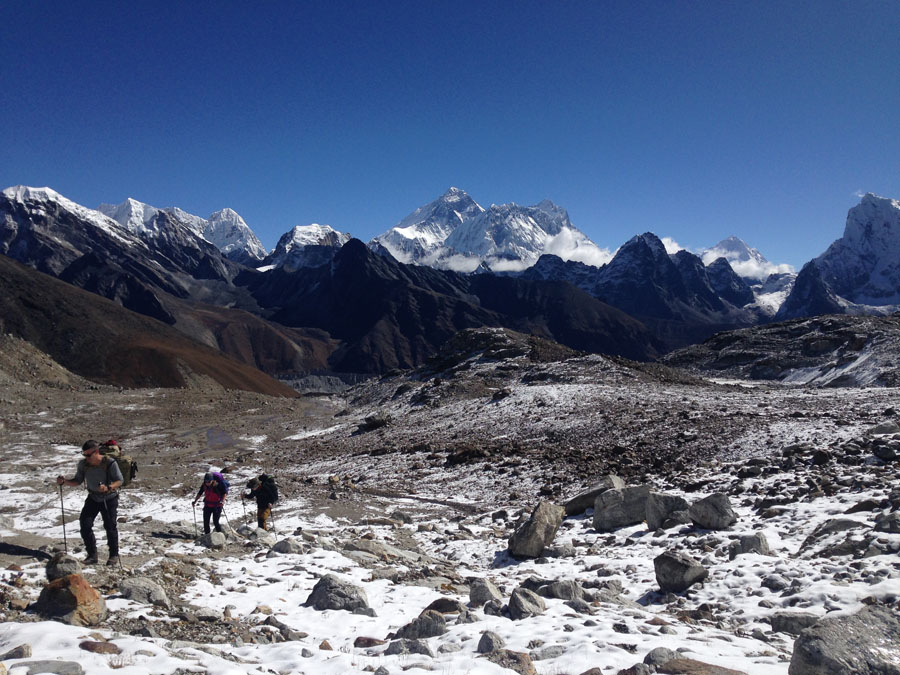
From Gokyo, the route continues toward Cho La Pass (5,420 m), the high mountain pass connecting the Gokyo Valley with the Everest Base Camp trail. Crossing the pass is one of the most demanding sections of the trek, involving steep and rocky terrain and, depending on the season, snow and icy conditions. The effort is rewarded with dramatic views of surrounding peaks, glaciers, and high Himalayan landscapes.
After crossing Cho La, the trail descends toward Dzongla and Lobuche, where it joins the main Everest Base Camp route. From here, the trek continues toward the Everest region's celebrated viewpoints, including Kala Patthar, which provides an impressive perspective of Mount Everest and the surrounding peaks. The trail also passes beneath the imposing Lhotse Face, one of the most remarkable walls of high-altitude rock and ice in the Himalayas.
The return journey follows the classic Khumbu trail through Tengboche, home to the famous Tengboche Monastery and an important spiritual centre for the Sherpa community. Surrounded by magnificent mountain scenery, Tengboche provides a memorable cultural dimension to the trek before the trail gradually descends toward Lukla.
Because the route involves several days at high altitude and crosses Cho La Pass above 5,000 metres, proper acclimatization is essential. A well-designed itinerary includes acclimatization and rest periods, allowing the body to gradually adapt to the increasing elevation. Trekkers should also be physically prepared for long walking days, steep ascents and the demanding conditions encountered at high altitude.
Overall, the Gokyo Cho La Pass Trek offers a comprehensive Himalayan experience, combining glacial lakes, high mountain viewpoints, a challenging Himalayan pass, Sherpa culture, monasteries, glaciers, and iconic Everest scenery. It is particularly suited to trekkers looking for a more adventurous and varied alternative to the standard Everest Base Camp route.
Today is your arrival day. we welcome you upon your arrival at Kathmandu’s Tribhuvan International Airport. Transfer to Hotel in Kathmandu. Prior to the activities, arrange a meeting with your guide for briefing about the necessary formalities on your tour and trek program. Depending upon your arrival time you may spend free time visiting nearby historic/Countryside areas.
Half day sightseeing in the UNESCO enlisted Kathmandu World Heritage sites Pasupatinath, Boudha Nath and Kapan Monastery etc where your guide will accompany you. Find a unique fusion of Hinduism and Buddhism in these shrines made with Newari art and architecture. They reflect ancient golden era of Nepal.There is time to explore the city’s many places of interest with your guide or in your own. Our Trek Leader/Guide meets you in the afternoon for the trek briefing and for the final trek preparation. In the evening sample a delicious traditional Nepali Welcome dinner in authentic Nepali Restaurant with the cultural dances that represents different customs and music instruments of Nepal. Private vehicle is there for you to pick up and drop in Hotel with our staff. Overnight in Kathmandu
Early morning you will be picked up by your guide to go to the Kathmandu airport, from where we will take the airplane to Lukla, which will take us about 30 minutes of flight time. At Lukla we will be received by our porters and tol head north from the airstrip to Cheplung (2700m). Here we will cross the Tharo Kosi river on a local-style suspension bridge. Just past the bridge we can see the peak of Kusum Kangru (6367m), which is the most difficult of the so-called “trekking peaks”. Beyond the Tharo Kosi the trail climbs a bit towards Ghat (2590m), we will cross a ridge marked with painted mani stones and climb to Phakding where we will stay overnight (3 hrs).
From Phakding we follow the valley of the Dudh Kosi river, staying on the west bank of the river. We climb steeply over a rocky ridge towards Benkar (2710m). From here the trail continues alongside the river. All along this part of the trail, villages are interspersed with magnificent forests of rhododendron, magnolia and giant firs. In both the early autumn and late spring, the flowers on this portion of the trek make it a beautiful walk. We cross the Kyashar Khola river and climb out of the valley to Monjo (2840m). Just beyond Monjo the trek enters the Sagarmatha (Everest) National Park, which was established in 1976 to protect 1148 sq km area surrounding Mt Everest. Beyond the national park entrance station, the trail makes a steep rocky descend and crosses the Dhud Kosi river on a 120m-long suspension bridge towards Jorsale (2830m). After crossing this river and climbing our way up the valley for a while, we reach Namche Bazaar (3420m). Namche Bazaar is the main trading centre in this region and features numerous shops, hotels and restaurants (6 hrs).
We stay at Namche for a second night to allow us proper acclimatization to the high altitude and to enable full exploration of the town and its surrounds. Namche is a prosperous village, situated in a large, protected hollow. It gained its importance during the period when Tibetan salt was traded for the lowland grains of Nepal. Today quite an amount of trade continues at Namche and Tibetans are sometimes seen in the village trading rugs and Chinese-made goods, clothing, salt and dried meat. It is recommended that you take the opportunity to see both the sunrise and sunset views from the national park headquarters above the village. The panorama can be stunning at both times of the day with a superb view of the Khumbu peaks, including great sightings of Everest. After breakfast there are various options, including a walk with a series of great peaks rearing to well over 6,000 meters just to the west. Alternatively you can visit the national park headquarters to see the interesting displays of Sherpa lifestyle and culture. Your guides will be on hand to offer advice and to escort you on the walks. Another option is the steep climb out of the village bowl to the flatter areas around and above Shyangboche, Everest View Hotel where beautiful views of Everest, Amadablam, Lhotse, Tawoche, Peak 38, Thamsherku abond.
Trek from Namche Bazaar to Dole (4090m.) via Khumjung takes about 7 hours. From Namche the route heads up all the way to Kumjung, a picturesque village which also has its own gompa at the top end of town. Here you can have excellent views of Thamserku, Kantega and Ama Dablam. Soon after leaving Khumjung the trail climbs to a large chorten on top of a ridge. This ridge descends from Khumbila, a 5734m peak, said to be the abode of the patron God of the Khumbu region. The trail descends slightly towards the Sanasa and then trail ascends up to Mongla (4000m.). From here, you can see panoramic views of various mountains. You trek steep down passing through Phortse Tenga and from there, the trail climbs dramatically up to Dole, through rhododendron and birch forest festooned with hanging mosses and lichens. You can enjoy delicious meal at Phortse Tenga (3650m.).
The trail starts today by climbing steeply through scrub junipers to a single lodge at Lhabarma (4330m). We pass the small settlement of Luza (4340m) and continue to climb along the side of the valley, high above the river to Machhermo. It was here that a yeti supposedly killed three yaks and attacked a Sherpa woman. This is the most credible yeti incident ever reported, so be watchful as we visit this region (4 hrs).
Beyond Machhermo the trail climbs a ridge for an excellent view both down the valley to Kantega and upwards to Cho Oyu. Beyond the ridge the valley widens as the trail reaches the small village of Pangka (4390m). After passing Pangka the trail drops briefly, then climbs to a large cave known as Nilibuk. After Nilibuk we climb steeply along a narrow, newly crafted staircase trail. Atop the staircase the trail crosses a simple wooden bridge to the first small lake, Longponga, at 4650m. The trail now becomes almost level as it follows the valley past a second lake, known as Taujun, at 4710m and finally up a boulder strewn path to Gokyo. Gokyo is a collection of stone houses and walled pastures on the shores of a large lake known as Dudh Pokhari (4 hrs).
The views around Gokyo are tremendous. For the best views we will climb Gokyo Ri (5357m) today. From here we will have a panoramic view of Cho Oyu, Gyanchung Kang, Everest, Lothse, Makalu, Cholatse and Tawachee. After we enjoy the view we will return to Gokyo village for the night (4 hrs).
Today we descend to leave the Gokyo Lakes to Dragnag which is the gateway to the Chola Pass. We turn left and the north between the first and second lake of Gokyo where we will be ascending a bit to the ridge from where we can see the longest Ngozumba glacier of Mount Cho Oyu. Down from here we start crsossing the solid parts of the Glacier sighting the turquoise compilation of ice formed by the glaciers.It takes nearly 45 minutes careful crossing to the grazing place of the Dragnag.You will have plenty of time to explore around or just relax for the next big and Long day.(3 hrs)
We start early in the morning having had a cup of tea and some biscuits and our staff carry pack lunch for all the members. As soon as we head up along the steep gorges we start feeling high up and the mountains appearing in the dawn. We arrive at the first top of the ridge where there are big stones from where we see the clear way to the Chola pass.From here the trail is turning and twisting around 1;30 hours down to the base of Chola.We start climbing slowly the final odd steep ascend to the top carefully over the loose rocks and loose snow.It might take nearly 2 hours to get to the top where you you will find the prayer flags and the ecstasy of being in the snow capped top surrounded by the mountains like Lobuche peak, Chola Peak, and the sceneries beyond. We descend stepping carefully in this odd snowy trail toward the valley to Dzongla. After Dzongla, we walk further to Lobuche for the easy and comfortable stay after crossing and turning ridges parallel to Lobuche peak, Dughla, Pheriche and soaring mountain Nuptse.(9 hours)
We have this day to rest in Lobuche making ourselves active for few hours in the nearby top ridges of the mountains
After a leisurely breakfast we follow the broad valley running parallel to Khumbu Glacier. The trail ascends only gradually to the moraines of Changri Nup Glacier, but from here we make a series of small ascents and descents over a rocky trail lined with cairns that leads eventually to Gorak Shep (5200m). After lunch we set off uphill to Kala Patar (5630m) to experience the sensational sunset views from this amazing vantage point. It will probably take a good hour and a half to reach the summit from Gorak Shep, although lower viewpoints may provide views almost as good. In front of us are Pumori, Nuptse, Changtse, Ama Dablam, Taweche, Kantega and Everest - the highest mountain in the world. We have excursion to the Everest Base Camp after the lunch which is the fun filled high altitude walking along the Khumbu glacier to this triumph and tragedy spot at the elevation of 5430m.This excursion can be taken as the optional for those who desires to see only the giant mountains.(6 hours)
After an early morning rise we will start our day by climbing the Kala Pathar (5550m) below the Giant Mount Pumori. This is a steep ascent up the grassy slopes west of Gorak Shep. From Kala Pathar the entire Everest south face is visible as well as Lho La (the pass between Nepal and Tibet), Changtse (the northern peak of Everest), Nuptse, Lingtren, other numerous peaks and most of the West-Ridge route. We return to Gorak Shep and continue to descend to Lobuche. To go to Dingboche we retrace our steps back to Dughla, and then go straight up the hill from the bridge to reach an upper trail, staying high above the valley floor. The views from here are great. You can easily recognise Island Peak and the top of Makalu is conspicuous in the distance over the pass to the right of Island Peak. After passing a chorten we will descend to Dingboche to stay the night (6:30 hrs).
Today we are in the valley of Imjatse or valley of Island Peak.Imjatse is climbed as the rehearsal peak by the Everest Climbers.This valley is superb in itself as it is surrounded by the stunningly beautiful mountains –Amadablam,Lhotse, Makalu, Island Peak, Kantega,Pathivara,Mingbola etc. We start day hiking to Chhukung ri(4952m) for the best views of the mountains and to feel and experience the beauty of base of Island peak. We stop in this tranquil area for the lunch break and return back to Dingboche.(5hrs)
The route from Dingboche descends to the Imja valley, then crosses the Khumbu Khola on a wooden bridge and climbs to rejoin the upward trail via Sommare. From Sommare the trail descends down along the Imja River to Pangboche village. Pangboche village is known as the village and the lodges owned by the Everest Climbers. Through gradual up and down after Pangboche we cross the steel bridge and head south through the dense forest of Rhododendron and Birch trees,Dibuche Nunnery to meadow of Tengboche Monastery.Here we enjoy the bread and the views together (4 hrs).
From Tengboche we descend steeply to the suspension bridge at Phunkitenga and after a break and a cup of tea we cross the Dudh Kosi and ascend to Tashinga. From here the trail contours high above the valley through Shanasa before returning to Namche Bazaar, where we take lunch and enjoy a final opportunity to visit the shops in the bazaar. ( 5 hours)
Today we slowly head back to Phakdingma through the busy Namche.We descend down to Jorsale bridge through the jungle and rough trail down and then walk to the Monjo through river bank, cross long suspension bridge and then gradual up and down to Phakdingma. There is no rush today as we retrace our steps back to Lukla. We head forward from Phakding after the Lunch and, although the final ascent up to Lukla is a surprise for most trekkers, reach the airport in the early afternoon. Lukla is famous for its end of trek celebrations, although we should not overdo it, as the plane ride back to Kathmandu is not best enjoyed with a hangover! (3 hours)
We rise early in the morning to be ready for the arrival of our aircraft for the flight back to Kathmandu. We are met at the airport and transferred to our hotel, located in Kathmandu (have a choice of Hotel). You do not miss to clean yourself, laundry and rest to feel low altitude. In the Evening have a party night .Our guide can recommend you the best and memorable restaurant to experience party time and place.
Our Tour officer meets you in Hotel for the Departure Transfer to Kathmandu’s International Airport. We anticipate welcoming you back to Nepal for various other stunning Trekkings or looking forward to serving you in our other country travel arrangements.
You Might Also Like